The scholarship that came full circle
The telegram arrived at a student flat at Monash University on 6 March 1980. Although the telegram has long since been misplaced, Myint still remembers its message.
“Glad to offer ANU Master Degree Scholarship for Master of International Law by course work. Please respond by 11 March [1980]. Regards Dicker Natuniv [late G. E. Dicker, then Registrar of the Australian National University]”
Halfway through a Master of Laws (by coursework and minor thesis) at Monash University, Myint applied for scholarships at both Monash and The Australian National University, hoping one would allow him to continue his studies with financial support. Although Australian universities did not charge tuition fees at the time, following the Whitlam Government's reforms, a scholarship offered both financial security and recognition. While studying at Monash, he also undertook occasional clerical work for the late Professor Enid Campbell.
Monash's law scholarships went to two other candidates one for a Ph.D., and one for a Master.
The Australian National University offered him one.
Even then, he initially hesitated.
Unsure whether to leave Monash, Myint sought the advice of the late Ms. Francine McKniff, then Sub-Dean of the Monash Law Faculty. Her advice was unequivocal: accept the ANU scholarship. In a letter to Dr Jean-Pierre Fonteyne, who coordinated the graduate international law program at ANU, she wrote that while Monash was sorry to lose him, "the realities of finances are such that we wish him all the best for his work in Canberra."
A few days later, Myint found himself hurrying through Melbourne Airport towards his flight to Canberra.
A member of the ground staff asked him.
"Have you been on a plane before?"
"Yes."
"Then don’t walk, run to the boarding gate."
He still smiles at the memory.
It was a short flight, but one that quietly changed the course of his life.
Looking back, Myint often reflects on how easily things might have unfolded differently. Had Monash awarded him a scholarship, he says with a smile that he might have become a donor to Monash (instead of ANU). Instead, what he calls (personal) "iffy history" led him to ANU, the institution that recognised his potential at a pivotal moment.
That recognition has never left him.
"Scholarships provide not only financial assistance," he says. "They provide psychological support and validation. Someone believes in you."
Today, through the Myint Zan Scholarship in the Master of Asian and Pacific Studies (MANPS), he hopes another student will experience that same belief.
For Myint, supporting MANPS was never simply about funding a degree. It was about supporting a way of thinking.
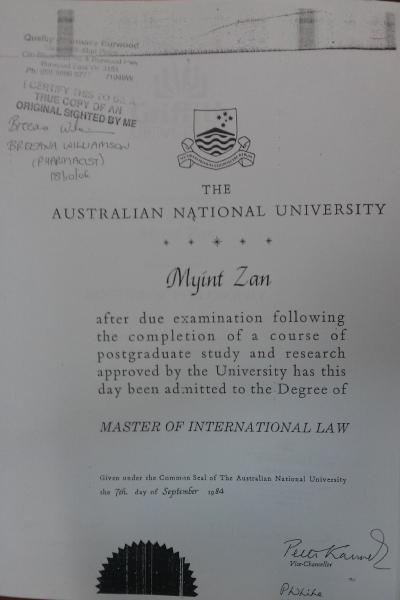
Over more than four decades, his work has crossed international law, legal philosophy, Burmese legal history, aspects of Asian legal systems—particularly Malaysian law—and human rights. He has taught across Australia, Malaysia, the South Pacific and the United States, while mentoring generations of students through mooting and serving as a judge in national and international moot competitions.
Rather than seeing knowledge through the lens of a single discipline, Myint has always been drawn to the questions that lie between them—where history informs law, politics shapes society, and culture influences the way nations understand one another. It is this intellectual breadth that led him to support the Master of Asian and Pacific Studies.
Offered through the School of Culture, History & Language within the ANU College of Asia and the Pacific, MANPS brings together history, politics, languages, culture and society to help students understand one of the world's most dynamic and strategically significant regions. For Myint, it reflects the kind of interdisciplinary education that shaped his own thinking.
"As Australia's engagement with Asia and the Pacific continues to deepen," he says, "graduates who understand the region in all its complexity will have an important role to play."
Myint's philanthropy extends well beyond ANU. He has established prizes and endowed funds at the University of Michigan Law School, another of his alma maters, and the University of Pennsylvania in honour of his late parents, whose own lives were devoted to medicine, scholarship and public service. His father, Dr San Baw, was an internationally recognised orthopaedic pioneer, while his mother, Professor Dr Myint Myint Khin, was a physician, educator and author. After her passing, Myint spent several years locating and assembling the manuscript before editing and publishing his mother's book, Burmese Women Through the Ages: The Heritage, in December 2023 to mark the centenary of her birth. He later presented a copy to the ANU Menzies Library, hoping it would benefit current and future students in the Master of Asian and Pacific Studies.
He has also supported the U Hla Tun Cancer Foundation and Hospice in Myanmar in memory of his late parents. Yet ANU remains the focus of his largest philanthropic commitment. At the heart of that commitment is the Master of Asian and Pacific Studies, alongside gifts to the ANU College of Law and the Department of Philosophy.
The decision reflects not only his academic interests, but also the people who shaped his own journey.
Looking back on his time at ANU, Myint speaks just as readily about mentors as he does about scholarships. He remembers Dr Jean-Pierre Fonteyne, who taught international law, Dr Peter Drysdale, whose courses in international economics broadened his thinking, and Robin Burnett, who introduced him to international human rights law and the legal aspects of international trade.
They challenged him, encouraged him and recognised his potential long before his career was established.
One piece of feedback has stayed with him. After submitting an essay that exceeded the word limit in the subject, Principles of International Economics, he found a handwritten note from Dr Peter Drysdale at the end of his own handwritten paper:
"Either you cannot count or I cannot count."
Still, Dr Drysdale gave him 77 per cent in the course.
More than three decades later, Myint reminded Peter Drysdale of the exchange. By then an Emeritus Professor, Drysdale graciously replied that perhaps he should have awarded Myint even higher marks.
For Myint, those moments capture something enduring about universities. Great teachers do more than pass on knowledge. They recognise potential before success is obvious.
That same philosophy now shapes his philanthropy.
The inaugural recipients of the MANPS scholarship, including Amy Macfarlane and Patricia Greaves, have since graduated, while the scholarship continues to support new cohorts of students.
Among the many messages Myint has received from scholarship and prize recipients over the years, one has stayed with him. A recipient of his Philosophy of Science Prize at ANU wrote that she had been living in a caravan when news of the award arrived.
More recently, 2025 recipient Zixin Huang described the award as "a surprising gift" that not only eased the financial burden of studying as an international student but also gave her "the confidence and motivation to continue pursuing my academic goals."
Reading those words, Myint sees echoes of his own experience more than four decades earlier.
Financial assistance matters.
So does knowing that someone has recognised your potential.
The telegram that arrived at a student flat at Monash University in March 1980 has long since disappeared.
Its message, however, still echoes.
Each year, another student receives an offer. Another future quietly changes direction.
That is the enduring legacy of a scholarship: not simply the education it makes possible, but the confidence that comes from knowing someone believed in your potential before the rest of the world had the chance to see it.